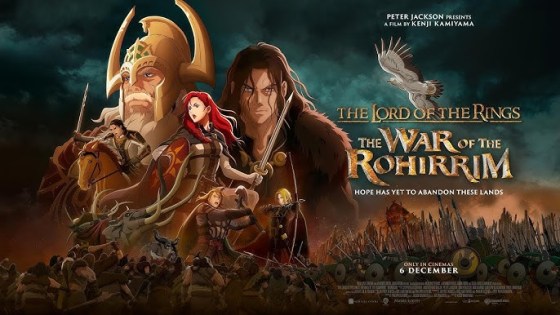
REVIEW of War of the Rohirrim (spoilers)

The War of Rohirrim’s plot was well done and extremely book accurate which is so nice to see in an Middle-Earth adaptation. The movie starts out with Miranda Otto reprising her role as Eowyn to narrate the movie. Eowyn gets us back into the Middle-Earth mind set and sets up the time frame of the movie which is 183 years before the LotR. Eowyn also introduces us to one of the main characters, Hera, and how she was raised by a warrior king. Eowyn says do not look at the old songs for mention of her because there is none, and that is because in the original story she is just the unnamed daughter of Helm. The plot then ramps up into a brawl then a war. We saw all the lore monuments that we expected to see including the Brawl, the siege of the Hornburg, and the death of Helm; and in the end, a certain white wizard comes to take over Isengard. The plot flowed well even with the several time jumps which are hard to do but they all worked great.

My top favorite character is Helm Hammerhand. His voice, played by Brain Cox, was great and what I imagined for his voice. The brawl scene and war council scene splendidly showed Helm’s arrogance and how he is not the best hero or king. The scene when he freezes to death fighting an army of Dunlendings was a stunning sequence where he somewhat redeems himself protecting his daughter and the gate.

Fréaláf was another great character. When he is scolded for making the wise plan of defense, he was outcast from the army even though his plan was a good one. To see him on the throne at the end was fitting and satisfying. Fréaláf at Dunharrow had great visuals; Dunharrow looked just like the stronghold from the original film despite this one being Anime.

I enjoyed the opening scenes and the visuals of the Hornburg; the ice and snow was cool (pun intended). I love how you did not immediately see Helm attack, and in a way, you felt the terror of the Dunlendings as the Wraith of Helm Hammerhand stalks you in the frozen night.

The two Orcs collecting rings was a fun original aspect. It worked well in the movie and did not contradict any lore. It made sense that Sauron, who desperately need his Ring back, would send out his orcs to collect rings in search of his or any other of the rings of power. It also makes sense how Sauron would not trust his orcs with the true knowledge of why they collected rings. And as a bonus, the orcs were ironically voiced by Billy Boyd and Dominic Monaghan (Merry and Pippin from the LotR films).

I enjoyed all the characters very much—they all fit really well with the lore and the world of Middle-Earth. However, there was one character who looked more Anime than Middle-Earth in style. Hama, the son of Helm Hammerhand, had very Anime boyband style hair and also had earrings. This look didn’t fit with the rest of the Rohirrim.

One thing I did not like was the whole Eagle plot. In a way, it cheapens the role of the eagles in the other movies. If every time one thing goes wrong the eagles are always there, it shows people as helpless. Tolkien did not write his stories that way.

The battle outside of Edoras was not as impressive as in the LotT trilogy because you did not get to see the scale of the battle. This is probably just because it is harder to do that in an Anime film.

Also, in the end the movie shows Hera overpowering Wulf in their fight. Realistically, that could not happen. She is somehow really good at climbing really, really high mountains without any training? Then, she is proficient in jumping large distances to large distances? It was somewhat unbelievable.

The movie was very lore accurate unlike some Amazon adaptations I have heard of. There were things they added (and almost every single one worked well), and there were no big lore cuts. I saw everything I wanted and expected to see lore-wise. I would venture to say this movie is more Lore accurate than the originals only because it has a lot less info to be true to. Despite this, I would still choose the originals over The War of the Rohirrim any day because Peter Jackson’s originals cannot be beat.

I really enjoyed the movie as a whole. It was so, so, so nice to get a good Tolkien adaptation after a gap of maybe 20 or more years. If the fact that it is anime bothers you, I encourage you to give it a shot. I have never liked Anime, but that was not a problem after the first 5 minutes. It was more Middle-Earth than Anime. I Give the War of the Rohirrim an 8 out of 10.

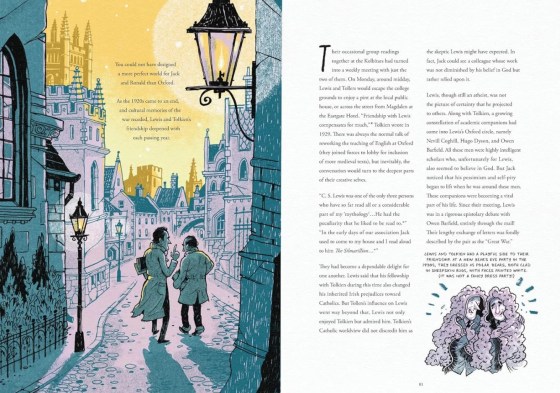
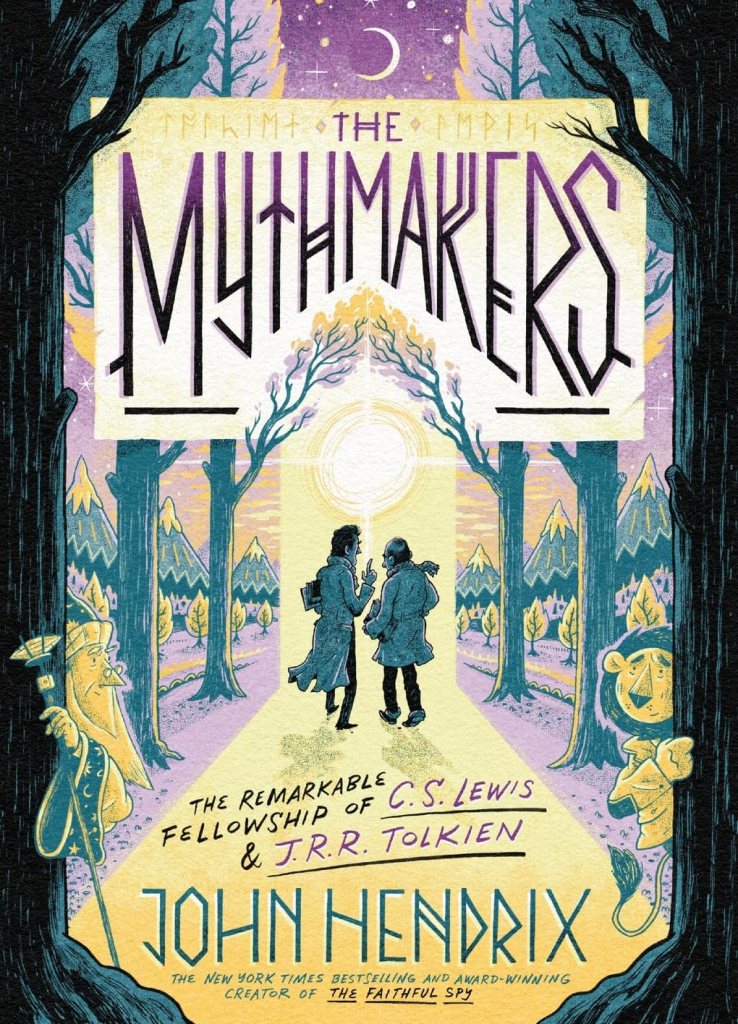
REVIEW of Mythmakers: The Remarkable Fellowship of C.S. Lewis and J.R.R. Tolkien, by John Hendrix

The Mythmakers, by John Hendrix, is a new book in the graphic novel format telling the tale of the remarkable fellowship of C.S. Lewis and J.R.R. Tolkien.

The content and storyline is amazing. The narrators, Mr. Goodwizard and Mr. Lion, walk the reader through the meaning and development through the meaning and development of the words myth, fairy tale, and fantasy. The narrators also show the lives of Lewis and Tolkien and how they created their respected stories. It captures their friendship perfectly, showing the sympathy and fellowship they had with each other.

The artwork and illustrations were high-quality. The cover looks stunning with the first-edition Hobbit background style and the four main characters of the book (Goodwizard, Lion, Tolkien, and Lewis). Throughout the book, the color theme is purple, yellow, and a dull blue, which look great when all together. Every character looks different, and it is really easy to tell them apart. Overall, I really enjoyed the art.

I had many favorite scenes from the book. One is C.S. Lewis’ conversion on the Addison Walk on pages 90-95. Some others are the Inkling Meeting on 104-107 and the coin flip (Tolkien and Lewis’ wager on who would write space travel or time travel stories) on pages 109-111. SPOILER ALERT: The book’s ending shows the true friendship between Lewis and Tolkien, and how the rift between them was healed in the end. The last chapter in the book is called “The Shadowlands and the Gray Havens,” a title I really appreciated.

I had high hopes for this book when I first learned of it, and The Mythmakers met those high hopes. The author, however, said in his note that there were more stories that he left out but wished he could have included. So, my least favorite part was that he didn’t do as many stories as he could have. An extended edition would be amazing, and I know many people would read it.

I give The Mythmakers a five out of five with its enthralling world, enchanting artwork, and entertaining story.

REVIEW of Rings of Power Season 2

Overview of Plot

The Rings of Power Season 2 plot was, for the most part, enjoyable and well-crafted. There were many good things about it, however, one of the lows was the Stranger/Harfoot/Rhun storyline. It was very disconnected to the rest of the world, and almost nothing significant happens compared to the other storylines. The first scene of the Stranger in the final episode was cut very strangely with no continuity from where we had last seen the Stranger with Tom Bombadil. I spent the entire scene thinking it was one of his visions or dreams, and I could not tell what was going on. Later in the episode, I realized the events of the scene had actually happened. I am not a fan of the Stranger turning out to be Gandalf. I was hoping for Blue not Grey. It is not how Gandalf was supposed to come to Middle Earth, and it is one age too early.

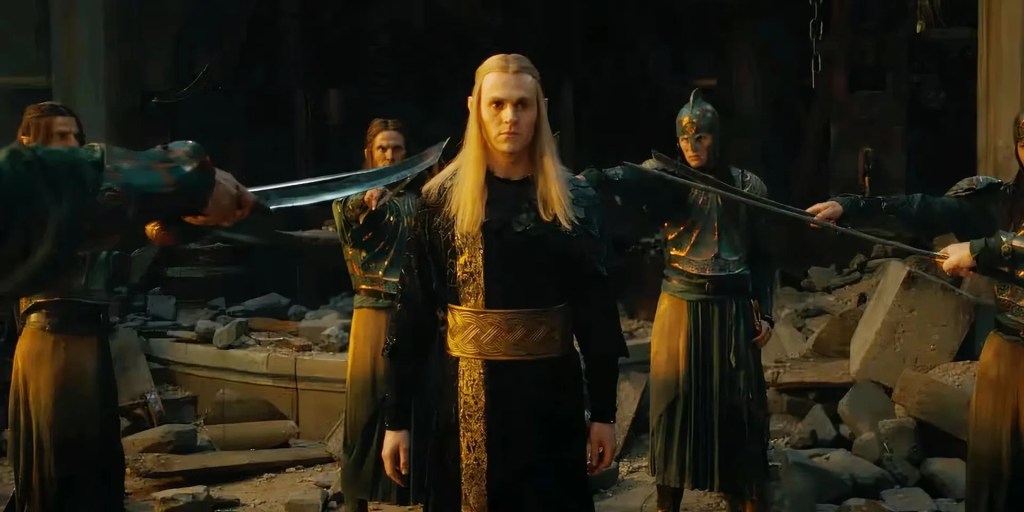
The Annatar/Celebrimbor part was by far the best thread. I liked how Annatar/Sauron played on Celebrimbor’s vices of pride and lust to create the best and most marvelous things of the age. Every time Celebrimbor started to catch on, Annatar manipulated him some more, making it Celebrimbor’s fault that the rings were flawed and turning the smiths and garrison of Eregion against him. It was enthralling to watch as Celebrimbor broke Sauron’s hold on his mind to get away and to prove whose will was mightier. In the end, he stood up against Sauron and died knowing that Sauron would one day be defeated.

The Southlands storyline served only to get Arondir to the siege of Eregion and make Theo in charge, and to introduce Isildur to his girlfriend who can’t go to Numenor with him (Boohoo!) At the ending of the Southlands story, it was fun to see Kemen demoted to the lowly task of dealing with the Southlanders after he messed everything up back home on Numenor with the Faithful and the Kingsmen.

The Khazad-Dum plot was good but could have been better. Durin IV was amazing. But Durin III’s ring obsession was too similar to the Bilbo scenes from the Peter Jackson LOTR trilogy. In the original story, the dwarven rings did not corrupt; they just enhanced wealth. But in Rings of Powers, they made the dwarven rings corrupt the king and drive him beyond sanity. During III’s last moments were moving as puts down the ring, tells his son he is strong, and jumps to strike the balrog. The balrog ends up killing the old king and collapses the passage. Although in the real lore, the balrog was not meant to be disturbed until much later, it was still an outstanding scene. The dwarf Narvi was nice to see, but it would have been nice to see more of him and Celebrimbor working together on the Doors of Durin and maybe even on the dwarven rings.

The Lindon, Elrond, and Galadriel plot was a fine plot–not the worst but not the best. Cirdan was a great canon character to see, and I really missed him in the second half of the season. I liked how Elrond was against using the rings, and it was fun to see him lead the charge of the Lindon army. Galadriel still needs improvement as a character, but she did get a lot, lot better. I enjoyed how when she sees the Eregion guards she puts them in their place by reminding them of Celebrimbor’s authority as the true lord of Eregion.

The Numenor plot was amazing, one of the best, how Ar-Pharazon steals Miriel’s eagle and throne and how the political infighting becomes serious. One nice part was when Elendil turned in his sword as he was stripped of his position, and Valandil said, “Captain leaving deck.” All the Faithful sailors turned and saluted in a dramatic gesture which made Kemen upset. Another great part was when Kemen killed Valandil and blamed Elendil for starting the fight. Elendil’s unwavering moral compass was nice and accurate of his character. He said lines like: “Faith is not faith unless it is lived,” making the Numenor plot great to watch.

Favorite Characters and Events

My first and most favorite character from Season 2 is Elendil. We got to see who he really was at his core this season, how when everyone else says Yes, he says No. He knows what is right and what is wrong. He lets nothing get in the way of his faith, even his family. The actor Lloyd Owens captured Elendil perfectly.

My second favorite character is Annatar, Lord of Gifts (Sauron). It was nice to finally get this plot back to canon, the way it should have been in Season 1. I like how he says that he will choose good, but every time a choice comes, he chooses evil. His romance with Mirdania is just a tool. When the time comes, he throws her off the wall, making it look like Celebrimbor did it. He manipulates nearly everyone in the show.

Some other great characters are Elrond, Arondir with his cool elf stunts, Cirdan, and Celebrimbor. These actors had amazing acting talents.

One of my favorite scenes is the Elendil trial where he says, “Yes, I will renounce my crimes. No, I will not pledge loyalty to Ar-Pharazon the traitor.” The tension and the Numenorean music playing in the background turns it into one of the best scenes.

Another great scene is when Narvi says to Durin IV, “There’s an elf that needs to talk to you,” and Durin says, “Let him in!” Narvi says, “We need to do it quietly, for this elf has been banished from all dwarven realms.” The Watcher and Durin both realize that it is Elrond at the same time, and we feel their deep connection.

A fun scene is where Arondir and Isildur kill the Nameless Thing and Arondir says: “There are many nameless things in the deeps of this world. This one we shall call…supper.” It was fun to see the grim and serious Arondir make a joke.

Least Favorite Characters and Events

My least favorite character is the Stranger because his story is boring and takes away from the Numenor and Eregion story, Oh yeah, and also because he is Gandalf.

I still dislike Nori (the Harfoot) a lot.

Tom Bombadil was cool to see. The actor looks like how I imagined him. But his outfit was poorly done. His bright blue jacket was more a pale, faded, ragged outer robe than “bright blue his jacket is.” His boots were yellowish leather, not really “big yellow boots.” His hat was not the pilgrim-style hat I imagined it to be. Also, his singing skills need to improve. It shouldn’t be non-emotional mumbles. It should be loud and jolly.

One thing I noticed in both seasons is that Galadriel really likes to take advantage of her “plot armor.” In Season 1, she walks into a volcano with no ill effects. In Season 2, she jumps off a cliff.

Hopes and Fears

I’m still hoping for my “Dead Men of Dunharrow” theory.

I enjoyed seeing Gil-galad fighting in the siege of Eregion and can’t wait to see him and Elendil team up against Sauron in the Battle of the Last Alliance.

I am scared where the Stranger…I mean, “Gandalf” storyline is going.

I hope Galadriel is done with being a rage monster for good.

Source Material

It was great to see key canon book moments like the forging of the rings of power, the siege of Eregion, the reign of Ar-Pharazon, and the finding of Rivendell.

I did not like the many out of place story bits like “Gandalf,” the balrog (although it was really cool), Tom Bombadil, barrow wights, and more.

There are several original aspects of the show such as Arondir’s thread, Isildur being stuck in Middle-earth, the majority of the dwarven plot, but they worked better with the world than the out-of-place, unchronological pieces of lore that were shoved into the second age.

Overall Assessment

Season 2 of Rings of Power was enormously better than its predecessor, Season 1. It had better canon moments and better storylines altogether. It wasn’t relying on one good storyline to hold up the rest of the show’s flaws, but had many strong threads that were enjoyable to watch.

I give it six out of seven dwarven rings, 7.5 out of 9 rings for men, and most of the hair on a hobbit’s toes.

Overall, it was a pretty good season. Cheers!

Rings of Power Theory

Alright, everybody! Rings of Power Season 2 is out, and it has been great.

After making it through Season 2, Episode 3, I have a theory about what might happen in the show. What if the Southlanders are the Dead men of Dunnharrow? Let’s explore the theory.

In the Rings of Power story of the Southlanders, Bronwyn who is an original character to the show somehow dies in-between seasons. Her son Theo runs into Isildur, and they start working together to save Isildur’s horse. But in the progress of saving the horse, Theo gets captured by an Entish creature.

Here is where my Theory really begins: Hopefully, Theo will be saved by Isildur. After that they will make a pact, and Theo will promise to repay Isildur. They will make it back to the Southlanders Camp to find the Southlanders leaderless! Theo will be made into their leader or king, and Isildur will find his way back to Numenor. Theo will lead his people to the White Mountains to rebuild themselves a kingdom.

Fast forward a few years. Isildur’s realm of Gondor is established, and the time has come for the Last Alliance of Men and Elves to muster all the allies they have to combat Sauron in Mordor. Isildur will travel to Dunharrow the newfound realm of the Southlanders to call upon Theo and the Southlanders to obey their oath. But the Southlanders and Theo still remember the destruction and death Sauron caused in their old homeland, and how long long ago theer people worshiped the evil of Sauron and Morgoth. And so the Southlanders will be too scared. They will forsake their oath to Isildur. Angered by this, Isildur will curse them for their faithlessness.

As the years pass, Theo would not fully die but becomes the wraith-like King of the dead. His people will be the Oath-breakers, the dead men of Dunharrow. Years will pass again, until Aragorn, the Heir of Isildur, comes to call on those Oath-breakers. He will summon them to fulfill their oath to Isildur from long ago and go to war against Sauron.

What do you think about my Theory?

if you like it, disagree with it, or have your own theories, please comment below, and share my page with your friends and family!

-A.L.Spears

(This is all a theory. It is not guaranteed to happen. I have no inside information. It is just an educated guess.)

The Middle-Earth Olympics

What would the Middle-Earth Olympics be like? It would be a game of good vs. evil. On one side you would have the evil forces of Sauron, Saruman, and Russia; on the other side you would have the forces of Men, Elves, and Dwarves representing the free peoples. It would be held in Michel Delving, the capital of the Shire.

There would be many different games such as a relay race of Man, Elf, and Dwarf vs. Uruk-hai, Orc and Troll. There would be archery contests, sword fighting tournaments, horse riding competitions, and swimming races.

One crowd favorite would be the River Barrel Race. How this sport works is the athletes ride barrels down a stream using all sort of weapons and battle tactics to defeat the other competitors, also mounted on barrels. The first one to make it to the end of the river alive with barrel intact is the winner.

This is only the tip of the iceberg when it comes to the Middle-Earth sports found in the Olympics.

***Disclaimer: The Middle-earth Olympic Committee is not responsible for any harm and injury or death caused by these games.

Here you have it, folks–what the Olympics would look like in Middle-Earth!

Upcoming Tolkien Adaptations (as of 2024)

There are several major Tolkien adaptations are coming up this year. You may know of some, but you may not be aware of others. So I am going to quickly cover what are the adaptations and when they are coming out.

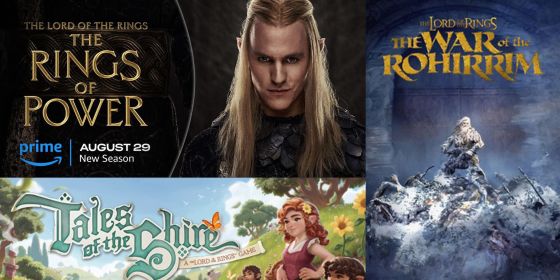
The Amazon television series season 2 will be premiering on August 29, 2024. They have sent out a full trailer in eager anticipation of the release date. From the trailer images, I think that season 2 will be so much better and lore-following than season 1. Also, allegedly, three episodes will be released on the 29th and the five next episodes will come out on a weekly basis.

The new Warner Bros. animated movie War of the Rohirrim is set to come up in December 13, 2024. the Executive Producer is Phillipa Boynes who is the one of the original producers of the Lord of the Rings movie. There is no trailer as of this date, but a few images have been released.

The Tales of the Shire is a video game. It is made by Weta Workshops game department. Weta Workshop is back! They worked a ton on the Lord of the Rings movie prop making and much more. the game is said to be a “Cozy” game. The Tales of the Shire is supposed to come out in the latter half of 2024.

Warner Bros. proclaimed that they will be making three new middle-earth films (not counting War of the Rohirrim) the first one of the Films is a Gollum movie covering Gandalf and Aragorn’s hunt for Gollum. Also, Peter Jackson is returning to lead yet another Middle-Earth film, but even better Andy Serkis is back to play Gollum and direct the movie. The first release’s date is some time in 2026 The other two movies have yet to be announced.

For those who are unaware of what an MMO is, it is a Massively Multiplayer game. Amazon is a making a LOTR game. My hopes are not high, but I will not condemn it before it comes out…I will wait and see. Its release date is in 2029, but it is so far out that the date could easily change.

I will eagerly await theses new adaptations like you all. My hopes are for the best adaptions of Tolkien’s world.

Inkling Pubs

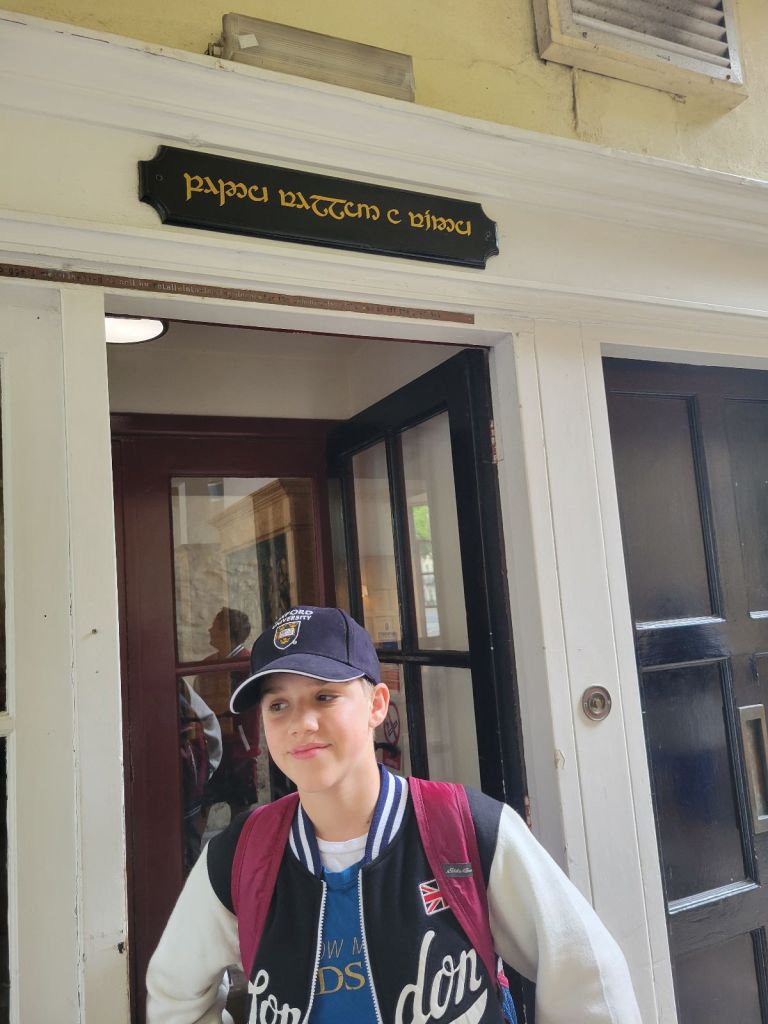
Hello, Everybody! I am writing this article from a cozy Airbnb in Oxford. Yes, the University Oxford! I was early this day walking around the town. I stopped and ate at Lamb and Flag. The Lamb was a frequented pub of the Inklings. It looks nice on outside and there is even an Elvish sign above the entrance. Also, around the back of the pub is an ancient looking path and an even older looking tree, but there in the path stands a lamppost…a Narnian lamppost perhaps.

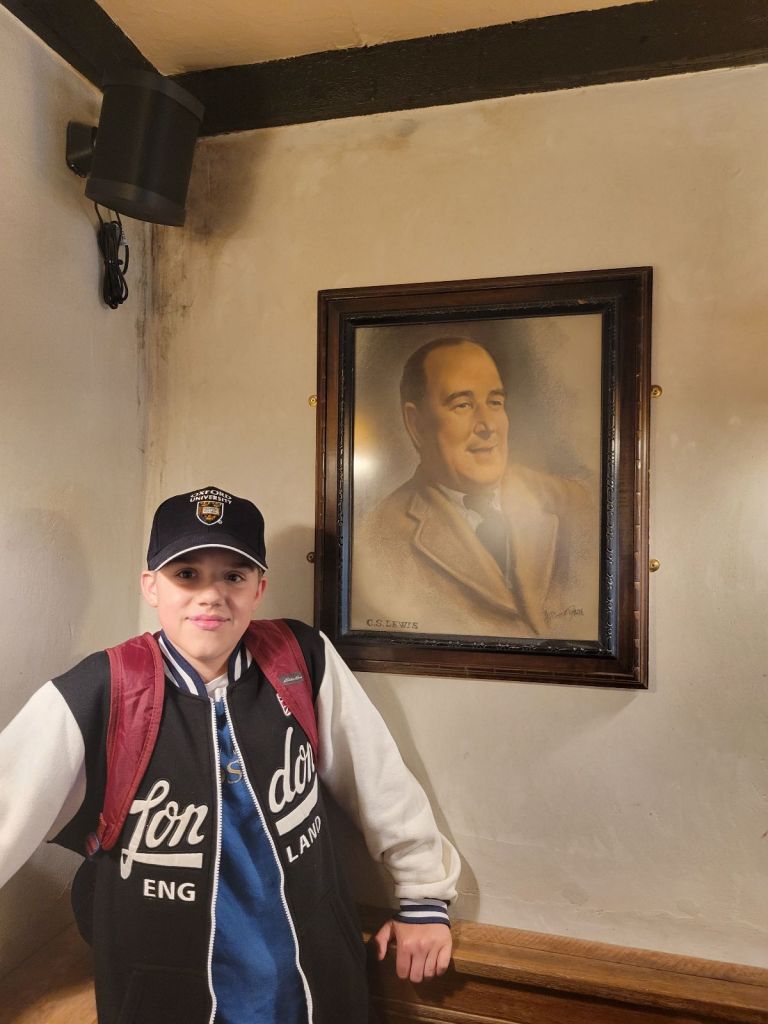
Upon entering, I found the building to be larger than I expected. I then notice the Tudor style rooms inside. Then I found a nice side room. I think it was the Inkling room. Why did I come to that assumption you may ask? Because there were two pictures adorning the wall. One was a photograph of the renowned J.R.R. Tolkien and his wife. The second an illustration of the famed C.S. Lewis.

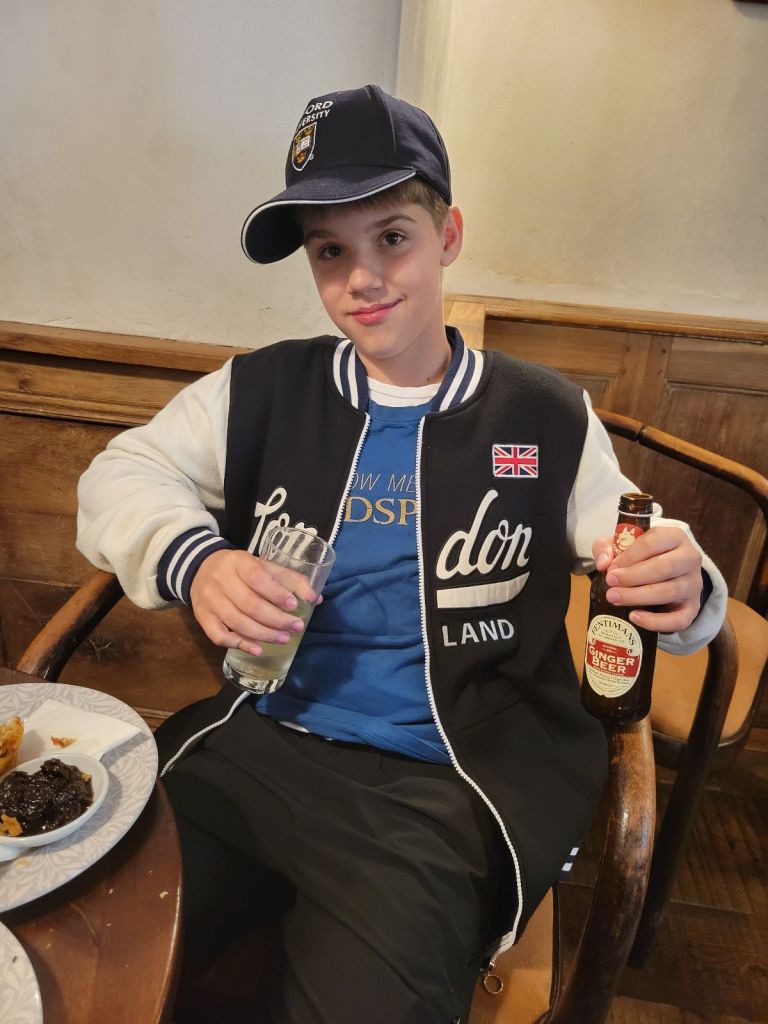
For a drink I had a decent Ginger Beer. For food, they do not sell warm food, so I had a cheese and ham croissant and a sausage roll.

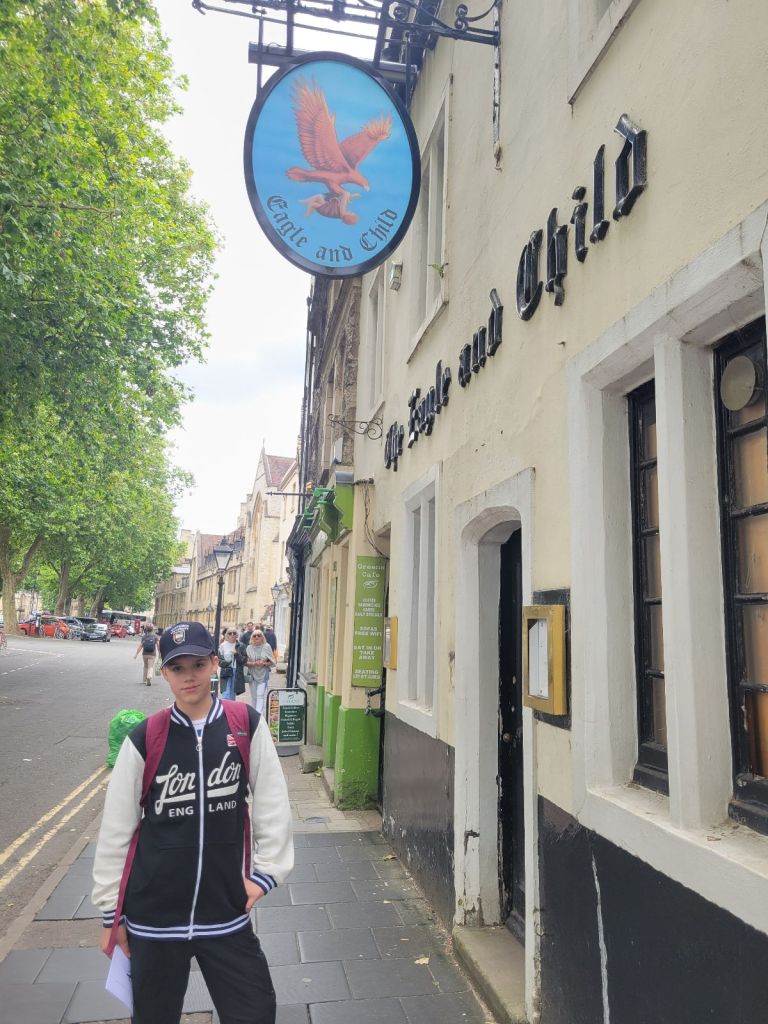
The Eagle and Child was closed, which was a disappointment, but it was still fun to see such an iconic and influential pub in the lives of Tolkien and Lewis and all the other Inklings!

-A.L.Spears

The Inklings Themselves

Who exactly were the Inklings?

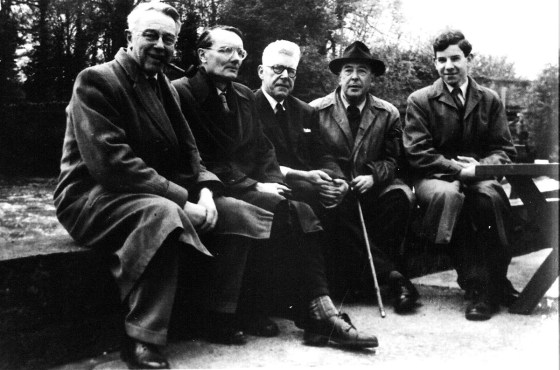
They were a literary group or club in Oxford, England. They frequented two Oxford pubs: The Eagle and the Child, and The Lamb and Flag. There were twelve regular members and frequent attendees of the Inklings.

J.R.R. Tolkien, possibly the most famous Inkling, was born in Bloemfontein, South Africa in 1892. He moved to England at a young age after his father died. He studied at Exeter College, Oxford. He served in World War One and became a professor of Anglo-Saxon at Oxford. He published The Hobbit in 1937 and The Lord of the Rings in 1954. He was a devout Catholic. He died in 1973 at the age of eighty-one years old.

C.S. Lewis, also possibly the most famous Inkling, was born in 1898 in Belfast, Ireland. He changed his name from Clive Staples to Jack. His mother died when he was nine. He served in World War One, and after the war worked at Oxford and Cambridge University. After World War Two, he wrote many books such as The Chronicles of Narnia, The Screwtape Letters, The Space Trilogy, and Mere Christianity. He died of kidney failure at the age of sixty-four.

Charles Williams was born in London in 1886. He went to school at St. Alban’s, and he worked at Oxford University Press. He published and wrote many things like poetry, theology, drama, history, biography, and book reviews. He lived too far from Oxford to be a regular member of the Inklings at first, but after he moved there he became a regular member. He died in 1945.

Owen Barfield was born in London. He went to school at Highgate and attend Wadham College, Oxford. He had a degree in English language and literature. He was an author and a poet and was a founding father of a new spiritual movement. Barfield was known as “the first and last Inkling,” founding the club and living the longest. In fact, C.S. Lewis dedicated The Lion, the Witch, and the Wardrobe to his daughter, Lucy Barfield. Owen Barfield died in 1997 at the age of ninety-nine.

Henry Victor Dyson Dyson was born in 1896. He was commonly referred to as Hugo Dyson. He was an expert in Shakespeare, but he was not a very active writer himself. Together, he and Tolkien converted C.S. Lewis to Christianity. He died at the age of seventy-nine in 1975.

Christopher Tolkien, the son of J.R.R. Tolkien, was born in Leeds, England. He was ever the little editor of his father Tolkien’s works from a very young age, criticizing the book if was not consistent. During World War Two, he served in South Africa as a British air force pilot. After the war, he attended Trinity College, Oxford. He was invited by his father to become a member of the Inklings. After his father’s death, he was the owner of the Tolkien estate and the editor of all Tolkien’s left behind works.

Warren Lewis, C.S. Lewis’ brother, was born in 1895 in Belfast, Ireland. For his career, he was an army officer and Irish historian. He fought in both the World Wars. He published several history books. Warnie was sadly an alcoholic and died at the age of seventy-seven in 1973 at Oxford.

Adam Fox was born in 1883. He was the headmaster of Radley College for some time. In fact, he was one of the very first Inklings. He wrote an enormous poem across four volumes titled, “Old King Cole.” He attempted to greatly promote Plato among the classics. He met his end in 1977.

Dr. Robert Emlyn Havard was the doctor of C.S. Lewis, Lewis’ wife, and Tolkien. He wrote the appendix for C.S. Lewis’ book, The Problem of Pain. Like Tolkien, he was a devout Catholic. One day when he was late to the meeting, Warnie Lewis referred to him as “the useless quack.” Following this, his nickname became “the U.Q.” On another day, Hugo Dyson called Havard “Humphrey” as he could not recall his first name. From that point on, the others called him Dr. Humphrey. He died in 1985.

Lord David Cecil, another Inkling member, was born in 1902 in England. He developed his love for reading because of a medical operation that made him stay in bed for a long time. He studied Christ College, Oxford. His first book was The Stricken Deer in 1929. He then worked on writings about Walter Scott and Jane Austen. Mostly working in Oxford as a professor, he joined the Inklings and eventually died in 1986 at the age of eighty-three.

Nevill Coghill was born in 1899. He was a director of drama and an Anglo-Irish scholar. He studied at Exeter College. He also made a modern version The Canterbury Tales and of Shakespeare’s works. He died in 1980.

Jack A.W. Bennett was born in Auckland, New Zealand. He studied at the University of Auckland, and sometime after this, he moved to Oxford and studied and taught there. He was the best known scholar of Middle English and was a fellow of C.S. Lewis. He died in 1980.

Now you will never forget the Inklings and how they have influenced our world today.

Tolkien’s Middle-Earth Inspirations

Many of you have read The Lord of the Rings, or at least watched the movies. (If you haven’t, then what’s wrong with you?!) But not everyone is familiar with the ways Middle-earth was inspired and created. Today I will tell you about the three main inspirations for Tolkien’s work: his language experience, the mythologies of early cultures, and the Bible. All of the information comes from books written by J.R.R. Tolkien and works about Tolkien by David Day. 

J.R.R. Tolkien wrote in one of his letters: “The invention of languages is the foundation. The ‘stories’ were made rather to provide a world for the languages than the reverse. To me a name comes first and the story follows.” 

Many modern fantasy writers make languages for their books but very few make books for their language. Tolkien was ever a linguist. He learned Latin as a boy. He was fascinated with Gothic, Old English, French, etc. He started to make up languages such as Nevbosh, which looked similar to Old English. He worked on his first prototype of Elvish in his late teens. When he got into Oxford, he studied to become a linguist. Later, he got a job as Professor of Anglo-Saxon. Near the end of his life, he received awards for The Hobbit and The Lord of the Rings, but the award he loved most of all was the one Oxford gave him for his linguistic pursuits. This award was not about his works, but it was about him, and his pursuit of language knowledge.

Tolkien’s linguistic learning provided inspiration for his books set in Middle Earth. There are over a dozen languages in the world of The Lord of the Rings. The common tongue, or Westron, is similar to our language English. Rohirric, the language of the Riders of Rohan, is similar to Anglo-Saxon, the language that Tolkien taught at Oxford.      

Tolkien has several different kinds of Elvish dialects for the high elves, the gray elves, and the silvan elves. Quenya is used for the high elves and is reserved for important, ceremonial moments. The grammar of Quenya is inspired by Latin and Greek and the vocabulary is similar to the Finnish language. Sindarin is the everyday Elven language. It is similar to Welsh and other Celtic languages. 

In Mordor, the Black Speech is used. This language is similar to ancient Mesopotamian languages. Tolkien designed it to sound rough and harsh. 

As you can see, Tolkien’s world was greatly inspired by the languages he studied and loved. From Anglo-Saxon, to Latin, to Celtic, to Mesopotamian, the languages of our world influenced the world of Middle-Earth. But these languages had myths and stories that go along with them.

Tolkien was also inspired by many European mythologies and legends. He incorporated elements from Greco-Roman myths, Norse mythology, and the tales of Arthur, Charlemagne, and Sigurd. 

The Greco-Roman myths inspired many things from Middle-earth such as the Valor. For those who do not know , the Valor are the gods with a lowercase “g”. Manwe, lord of eagles and ruler of the Valor is like Zeus, king of the gods. Ulmo, the lord of waters, is similar to Poseidon. And Aule, the smith and maker of the dwarves, is like the blacksmith god Hephaestus. Mandos, god of the dead and the doomsman of the Valor, is equivalent to  Hades, the Greco-Roman god of the underworld (although Mandos is a good version of Hades, not evil).

Besides the myths of Greece and Rome, Tolkien was also inspired by Norse or Viking mythologies. The name middle-earth itself came from Norse old English and Germanic. Also the forest of Mirkwood comes from a Norse word that I dare not pronounce. Mirkwood of Norse mythology was a dark and pathless forest. Many characters and creatures of Middle-earth originated in Norse tales and stories such as trolls, wargs, dwarves, elves, barrow-wights.

The stories of three great courts of the Middle Ages inspired Tolkien: the story of King Arthur and his knights, of King Charlemagne and his peers, and of Sigurd. For those of you who do not know who Sigurd is, he is a hero from the Volsunga Saga. Many people compare Aragorn and Gandalf to Arthur and Merlin, which is not wrong, but one also can and should compare Aragorn and Gandalf to Charlemagne and Turpin, and to Sigurd and Odin. The old mentor figures of Merlin, Turpin, and Odin share wisdom like Gandalf with the young hero. 

Aragorn, Arthur, Charlemagne, and Sigurd all bear magical swords forged long ago. Aragorn’s sword Narsil or Anduril was forged by Telchar, the dwarven smith of the first age. Arthur’s sword Excalibur was made in the legendary land of Avalon. Charlemagne’s sword Joyeuse [joy-ooze] was made by Wayland the Smith who also made many other famous swords. Sigurd’s sword Gram, which formerly belonged to Odin,  was also forged by Wayland. Tolkien connects his hero Aragorn with these legendary heroes by giving him a blade forged by a legendary smith from long ago.

Another major inspiration was the epic Beowulf. The original manuscript of Beowulf barely survived a fire in the library. But in the part where the thief is stealing the cup from the dragon, the page is burned. It never says who the thief was or why he stole the cup. In The Hobbit, Bilbo steals a cup from Smaug the dragon, and then Smaug takes out his anger on the lake men who are much like Beowulf. The Hobbit is Tolkien’s theory of the thief.

Tolkien was inspired by all the heroes and mythologies of Europe, but by none more than the true mythology of the Bible.              

Tolkien was influenced most of all by the Word of God. As stated before, the Valor are gods with the little ‘g’ but there is a being who is God with a big ‘G.’ His name is Eru, the One. Tolkien wanted his story to be like the mythologies that he loved, but he also wanted his world to be like the true story found in the Christian Bible. So he incorporated both.

Tolkien gives the elves their own Fall. After the lights of the world were destroyed, the elves rebelled against the Valar leading to exile and death.

Gandalf is one of the many little Christs of middle-earth. He departs from the fellowship and battles the Balrog (aka a Demon of darkness) for three days and then returns to the living as Gandalf the White to finish his task that Eru gave him to defeat Sauron.

Another little Christ figure is Frodo who carries the ring. This heavy burden is not his responsibility, but he shoulders it anyway, possibly a symbol of Christ bearing our sins. 

Yet another Christ figure is Aragorn. He is both a healer and a long-awaited king. His coming is prophesied in the poems of Middle-earth, just as Christ’s coming as king was foretold by the prophets of the Old Testament.

As you can see, Tolkien was inspired by many things to create his wonderful masterpiece that we cherish today. Some of his greatest inspirations were languages, mythology, and Scripture. Knowing about Tolkien’s inspirations furthers your enjoyment of his books and the movies based on them. 

Just like Tolkien, we can work hard at pursuing our own interests in school and in life. We can appreciate different aspects of history, literature, languages, and God’s creation, even if we don’t know how we will use these things at the time. Having a wide variety of interests will form who we are as people, and the more we understand of God’s world, the better we can create our own worlds, whether they be in books, art, music, movies, or games. 

So, the next time you read The Lord of the Rings, look for the hidden inspirations that make it so extraordinary, and get inspired to learn all you can so you can make your own world like Tolkien did.  – A.L.Spears

Food In the Hobbit

In The Hobbit food is abundant, from hobbit larders to troll caves. The hobbit society is based around food and drink as much as fellowship, and trolls bond over food as well. Other havens within The Hobbit, such as Beorn’s home, are also. marked by abundant food. Every culture in Middle Earth depends on food, but none more than the hobbits.

The hobbits cherish food like no other race, as demonstrated by Bilbo. Food is more than a life need. It is the fuel of their very society. It brings them together at the table, multiple times a day as they engage in the mannerly ritual of eating.

Trolls, on the other hand, are far less polite with their eating habits. Trolls generally eater whatever they can get. In The Hobbit, the three trolls that we encounter are having a supper of mutton (sheep meat). But trolls find man flesh the most delicious. In the story, they took a very long time to decide how to cook their food once they had caught it. The appetite of a troll is humongous.

Another humongous eater of Middle-earth was Beorn. Beorn is regarded as a good cook and host. Beorn collects most of his food, like milk and honey, from his animals. Beorn’s honey cakes are famous in Wilderland and loved by many. But Beorn seldom gives them to travelers.

Food throughout Middle-earth is cherished and loved, and hobbits, trolls, and Beorn all used food in their own way. The hobbits enjoyed cozy meals with tea and sharing conversation, the trolls scavenged for whatever they could find, and Beorn’s relationship with his animals provided bountiful food whenever it was needed. In every world, food should bring fellowship and friendship.

-A.L. SPEARS