
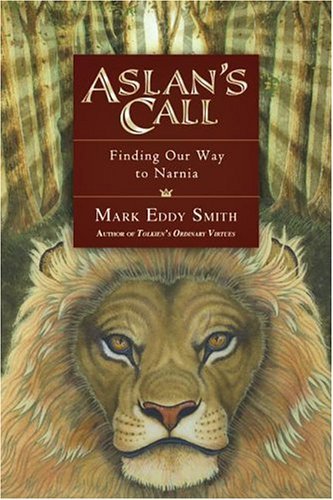
REVIEW of Aslan’s Call By Mark Eddy Smith

The Book Aslan’s Call is written by Mark Eddy Smith. It is a wonderfully crafted book that shows the deeper depths of the universal themes and Christian faith that run throughout the entire Chronicles of Narnia.

The book is divide into nine parts. Each part is very fascinating. The introduction sets your expectations for the book and explains what the book is. I highly recommend you start with the introduction and not skip it. The next seven chapters cover the Chronicles of Narnia book by book. The chapters are divided into several sub sections. They talk about the characters, the story, and the highlights of the plot, and you can learn something valuable from every section. The last chapter is the Afterword; it is divided up into two sections: (1) How Smith would feel if and when he meets Aslan, and (2) a short fictional story of someone reading the Chronicles for the first time. The first part of the Afterword, I really enjoyed, but the second part was not my favorite.

One example of the valuable lessons in this book is the description of the Cabby showing leadership in The Magician’s Nephew. Smith writes: “The Cabby’s thoughts are all for the group, keeping them looking on the bright side, even while acknowledging the dark truth that they might be dead. He sings a harvest hymn in a place where nothing seems ever to have grown. Is it any wonder that Aslan chooses him to be King?”

In another example in The Silver Chair, when the underworld is falling apart, Prince Rilian wishes he could follow the gnomes to Bism. “Rilian is faced with the same choice his father was decades earlier when he wished to abandon his kingdom to search for the end of the world… It’s a hard lesson. Our journeys, we feel, should be rewarded. We know Aslan would want to reward us, and here’s his chance!… The point is, if we’ve accomplished the task for which Aslan sent us into Narnia, we have done well…. The lure of the unexplored, of being discoverers and not just tourists, is grand and not to be scoffed at, but it is only one kind of adventure, and if that is the whole of our definition, then we will miss out on many more ordinary, common but no less magical adventures.”

Mark Eddy Smith provides some amazing insights in this book, and I hope you will appreciate them too. But remember, when Aslan calls for you, answer! Answer well, my brave reader.
The Life of C.S. Lewis

Who is C.S. Lewis? Today we will examine together who the man behind the Chronicles of Narnia truly is.

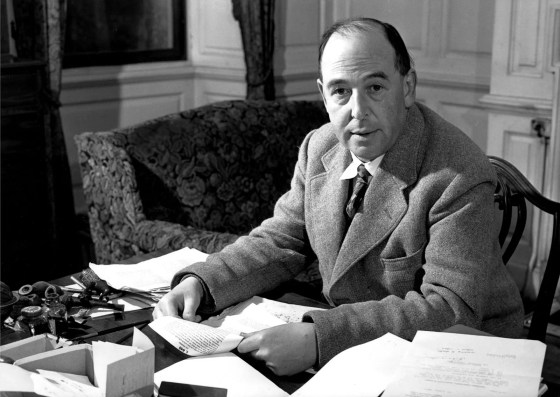
C.S. Lewis was born November 29, 1898 in Belfast, Ireland. His father was a lawyer and his mother was a mathematician who taught Lewis and his brother Warnie. Lewis’ full name was Clive Staples Lewis. As a kid, he did not like this horrid name, so he changed it to Jack. His mother died of cancer when he was nine years of age. His father sent him to a boarding school. His father was very demanding and did not understand how to raise children, and the brothers did not like their dad’s parenting skills. After his mother died, Jack left the true faith of Christianity.

Later, Jack studied under a tutor, the same one that his brother and father had studied under. He learned to read the classics in Greek and Latin. He was also greatly inspired by George MacDonald. He was studying for the Oxford exam, but he failed. He tried again and failed. Then he went off to serve in World War One. The experience influenced him greatly. He had a traumatizing time.

After the war, Oxford let soldiers enroll for many former students had died. Jack became a scholar and then a teacher at Oxford. He made friends with J.R.R. Tolkien and a club of writers called the Inklings that included Tolkien and Hugo Dyson. He reconverted to Christianity with the help of Tolkien and Dyson and they had a deep friendship.

After his conversion, World War Two overtook Europe. A few of the Inklings joined the war effort, and some of the younger Inklings enlisted as soldiers. Christopher Tolkien, the son of J.R.R. Tolkien, was one of these. Lewis met another great friend and Inkling, Charles Williams, during this time.

During and after the war, Lewis wrote many books including The Screwtape Letters, The Chronicles of Narnia, and The Space Trilogy. He took a position as professor at Cambridge since Oxford would not promote him. He married Joy Davidson in his fifties. A few years later, Joy got cancer and died. Lewis was greatly grieved and wrote a book on his sorrow. He died of kidney failure one week before his sixty-fifth birthday.

C.S. Lewis, or Jack, was a famous scholar, author, theologian, and Inkling.

Greek Mythology in Narnia

The Chronicles of Narnia by C.S. Lewis were greatly influenced by the myths of classical Greece. The fauns, dryads, and Bacchus all appear in Lewis’ tales alongside Aslan and the Pevensie children.

Mr. Tumnus, the faun from The Lion, the Witch, and the Wardrobe, and all other Narnian fauns were inspired by Greek fauns and Pan the demigod. Both Narnian fauns and Greek fauns all share the same appearance, being half-man and half-goat. The upper half is a man’s body with goat horns sprouting from the head. The lower half is goat legs and hooves. Mr. Tumnus has a wooden flute just like Pan’s, yet another similarity between the two.

Another Greek inspiration are the nymphs and dryads. For those who do not know, the nymphs are Greek water spirits, and the dryads are Greek tree spirits. The Narnian nymphs and dryads are very similar to the Greek ones and appear throughout the Chronicles. Virtually everything is alive in Narnia, from talking animals to tree and river spirits.

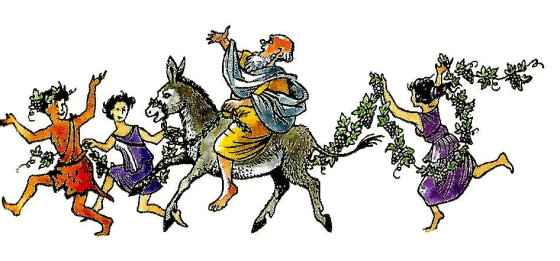
Along with demigods and nymphs, one of the Greek gods himself makes an appearance in the books. In Prince Caspian, it describes a wild feast where a man riding a donkey “who was old and enormously fat” is passing out refreshments. The refreshments consist of wine and grapes. The man, who we later learn is Bacchus, is surrounded by wild dancing girls. Bacchus is Dionysius, the son of Zeus, the god of wine and revelry.

As seen above, the Greek myths greatly inspired the Chronicles of Narnia, and the books would not be the same without them.