

Many of you have read The Lord of the Rings, or at least watched the movies. (If you haven’t, then what’s wrong with you?!) But not everyone is familiar with the ways Middle-earth was inspired and created. Today I will tell you about the three main inspirations for Tolkien’s work: his language experience, the mythologies of early cultures, and the Bible. All of the information comes from books written by J.R.R. Tolkien and works about Tolkien by David Day.
J.R.R. Tolkien wrote in one of his letters: “The invention of languages is the foundation. The ‘stories’ were made rather to provide a world for the languages than the reverse. To me a name comes first and the story follows.”
Many modern fantasy writers make languages for their books but very few make books for their language. Tolkien was ever a linguist. He learned Latin as a boy. He was fascinated with Gothic, Old English, French, etc. He started to make up languages such as Nevbosh, which looked similar to Old English. He worked on his first prototype of Elvish in his late teens. When he got into Oxford, he studied to become a linguist. Later, he got a job as Professor of Anglo-Saxon. Near the end of his life, he received awards for The Hobbit and The Lord of the Rings, but the award he loved most of all was the one Oxford gave him for his linguistic pursuits. This award was not about his works, but it was about him, and his pursuit of language knowledge.
Tolkien’s linguistic learning provided inspiration for his books set in Middle Earth. There are over a dozen languages in the world of The Lord of the Rings. The common tongue, or Westron, is similar to our language English. Rohirric, the language of the Riders of Rohan, is similar to Anglo-Saxon, the language that Tolkien taught at Oxford.
Tolkien has several different kinds of Elvish dialects for the high elves, the gray elves, and the silvan elves. Quenya is used for the high elves and is reserved for important, ceremonial moments. The grammar of Quenya is inspired by Latin and Greek and the vocabulary is similar to the Finnish language. Sindarin is the everyday Elven language. It is similar to Welsh and other Celtic languages.
In Mordor, the Black Speech is used. This language is similar to ancient Mesopotamian languages. Tolkien designed it to sound rough and harsh.
As you can see, Tolkien’s world was greatly inspired by the languages he studied and loved. From Anglo-Saxon, to Latin, to Celtic, to Mesopotamian, the languages of our world influenced the world of Middle-Earth. But these languages had myths and stories that go along with them.
Tolkien was also inspired by many European mythologies and legends. He incorporated elements from Greco-Roman myths, Norse mythology, and the tales of Arthur, Charlemagne, and Sigurd.
The Greco-Roman myths inspired many things from Middle-earth such as the Valor. For those who do not know , the Valor are the gods with a lowercase “g”. Manwe, lord of eagles and ruler of the Valor is like Zeus, king of the gods. Ulmo, the lord of waters, is similar to Poseidon. And Aule, the smith and maker of the dwarves, is like the blacksmith god Hephaestus. Mandos, god of the dead and the doomsman of the Valor, is equivalent to Hades, the Greco-Roman god of the underworld (although Mandos is a good version of Hades, not evil).
Besides the myths of Greece and Rome, Tolkien was also inspired by Norse or Viking mythologies. The name middle-earth itself came from Norse old English and Germanic. Also the forest of Mirkwood comes from a Norse word that I dare not pronounce. Mirkwood of Norse mythology was a dark and pathless forest. Many characters and creatures of Middle-earth originated in Norse tales and stories such as trolls, wargs, dwarves, elves, barrow-wights.
The stories of three great courts of the Middle Ages inspired Tolkien: the story of King Arthur and his knights, of King Charlemagne and his peers, and of Sigurd. For those of you who do not know who Sigurd is, he is a hero from the Volsunga Saga. Many people compare Aragorn and Gandalf to Arthur and Merlin, which is not wrong, but one also can and should compare Aragorn and Gandalf to Charlemagne and Turpin, and to Sigurd and Odin. The old mentor figures of Merlin, Turpin, and Odin share wisdom like Gandalf with the young hero.
Aragorn, Arthur, Charlemagne, and Sigurd all bear magical swords forged long ago. Aragorn’s sword Narsil or Anduril was forged by Telchar, the dwarven smith of the first age. Arthur’s sword Excalibur was made in the legendary land of Avalon. Charlemagne’s sword Joyeuse [joy-ooze] was made by Wayland the Smith who also made many other famous swords. Sigurd’s sword Gram, which formerly belonged to Odin, was also forged by Wayland. Tolkien connects his hero Aragorn with these legendary heroes by giving him a blade forged by a legendary smith from long ago.
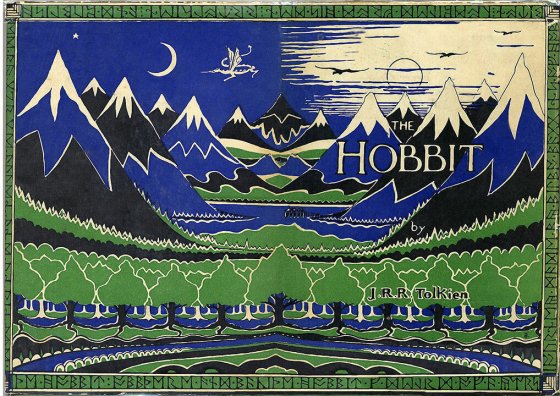
Another major inspiration was the epic Beowulf. The original manuscript of Beowulf barely survived a fire in the library. But in the part where the thief is stealing the cup from the dragon, the page is burned. It never says who the thief was or why he stole the cup. In The Hobbit, Bilbo steals a cup from Smaug the dragon, and then Smaug takes out his anger on the lake men who are much like Beowulf. The Hobbit is Tolkien’s theory of the thief.
Tolkien was inspired by all the heroes and mythologies of Europe, but by none more than the true mythology of the Bible.
Tolkien was influenced most of all by the Word of God. As stated before, the Valor are gods with the little ‘g’ but there is a being who is God with a big ‘G.’ His name is Eru, the One. Tolkien wanted his story to be like the mythologies that he loved, but he also wanted his world to be like the true story found in the Christian Bible. So he incorporated both.
Tolkien gives the elves their own Fall. After the lights of the world were destroyed, the elves rebelled against the Valar leading to exile and death.
Gandalf is one of the many little Christs of middle-earth. He departs from the fellowship and battles the Balrog (aka a Demon of darkness) for three days and then returns to the living as Gandalf the White to finish his task that Eru gave him to defeat Sauron.
Another little Christ figure is Frodo who carries the ring. This heavy burden is not his responsibility, but he shoulders it anyway, possibly a symbol of Christ bearing our sins.
Yet another Christ figure is Aragorn. He is both a healer and a long-awaited king. His coming is prophesied in the poems of Middle-earth, just as Christ’s coming as king was foretold by the prophets of the Old Testament.
As you can see, Tolkien was inspired by many things to create his wonderful masterpiece that we cherish today. Some of his greatest inspirations were languages, mythology, and Scripture. Knowing about Tolkien’s inspirations furthers your enjoyment of his books and the movies based on them.
Just like Tolkien, we can work hard at pursuing our own interests in school and in life. We can appreciate different aspects of history, literature, languages, and God’s creation, even if we don’t know how we will use these things at the time. Having a wide variety of interests will form who we are as people, and the more we understand of God’s world, the better we can create our own worlds, whether they be in books, art, music, movies, or games.
So, the next time you read The Lord of the Rings, look for the hidden inspirations that make it so extraordinary, and get inspired to learn all you can so you can make your own world like Tolkien did. – A.L.Spears

 Inkling Investigation