REVIEW of Mythmakers: The Remarkable Fellowship of C.S. Lewis and J.R.R. Tolkien, by John Hendrix

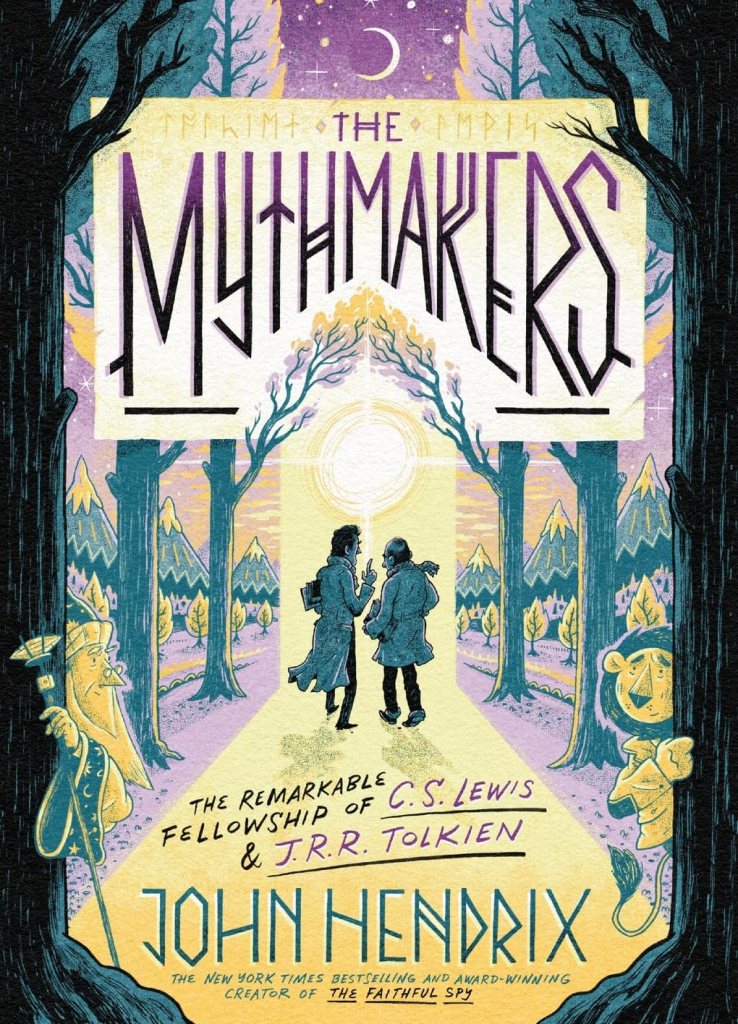
The Mythmakers, by John Hendrix, is a new book in the graphic novel format telling the tale of the remarkable fellowship of C.S. Lewis and J.R.R. Tolkien.

The content and storyline is amazing. The narrators, Mr. Goodwizard and Mr. Lion, walk the reader through the meaning and development through the meaning and development of the words myth, fairy tale, and fantasy. The narrators also show the lives of Lewis and Tolkien and how they created their respected stories. It captures their friendship perfectly, showing the sympathy and fellowship they had with each other.

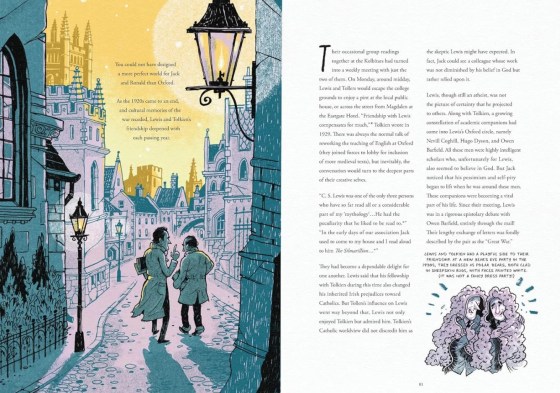
The artwork and illustrations were high-quality. The cover looks stunning with the first-edition Hobbit background style and the four main characters of the book (Goodwizard, Lion, Tolkien, and Lewis). Throughout the book, the color theme is purple, yellow, and a dull blue, which look great when all together. Every character looks different, and it is really easy to tell them apart. Overall, I really enjoyed the art.

I had many favorite scenes from the book. One is C.S. Lewis’ conversion on the Addison Walk on pages 90-95. Some others are the Inkling Meeting on 104-107 and the coin flip (Tolkien and Lewis’ wager on who would write space travel or time travel stories) on pages 109-111. SPOILER ALERT: The book’s ending shows the true friendship between Lewis and Tolkien, and how the rift between them was healed in the end. The last chapter in the book is called “The Shadowlands and the Gray Havens,” a title I really appreciated.

I had high hopes for this book when I first learned of it, and The Mythmakers met those high hopes. The author, however, said in his note that there were more stories that he left out but wished he could have included. So, my least favorite part was that he didn’t do as many stories as he could have. An extended edition would be amazing, and I know many people would read it.

I give The Mythmakers a five out of five with its enthralling world, enchanting artwork, and entertaining story.

REVIEW of Aslan’s Call By Mark Eddy Smith

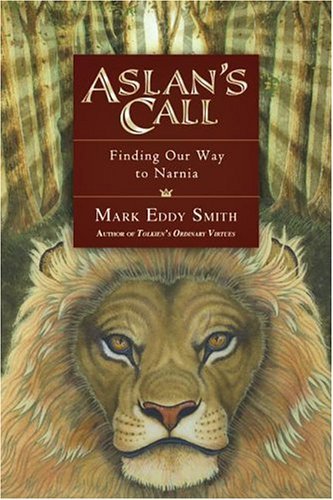
The Book Aslan’s Call is written by Mark Eddy Smith. It is a wonderfully crafted book that shows the deeper depths of the universal themes and Christian faith that run throughout the entire Chronicles of Narnia.

The book is divide into nine parts. Each part is very fascinating. The introduction sets your expectations for the book and explains what the book is. I highly recommend you start with the introduction and not skip it. The next seven chapters cover the Chronicles of Narnia book by book. The chapters are divided into several sub sections. They talk about the characters, the story, and the highlights of the plot, and you can learn something valuable from every section. The last chapter is the Afterword; it is divided up into two sections: (1) How Smith would feel if and when he meets Aslan, and (2) a short fictional story of someone reading the Chronicles for the first time. The first part of the Afterword, I really enjoyed, but the second part was not my favorite.

One example of the valuable lessons in this book is the description of the Cabby showing leadership in The Magician’s Nephew. Smith writes: “The Cabby’s thoughts are all for the group, keeping them looking on the bright side, even while acknowledging the dark truth that they might be dead. He sings a harvest hymn in a place where nothing seems ever to have grown. Is it any wonder that Aslan chooses him to be King?”

In another example in The Silver Chair, when the underworld is falling apart, Prince Rilian wishes he could follow the gnomes to Bism. “Rilian is faced with the same choice his father was decades earlier when he wished to abandon his kingdom to search for the end of the world… It’s a hard lesson. Our journeys, we feel, should be rewarded. We know Aslan would want to reward us, and here’s his chance!… The point is, if we’ve accomplished the task for which Aslan sent us into Narnia, we have done well…. The lure of the unexplored, of being discoverers and not just tourists, is grand and not to be scoffed at, but it is only one kind of adventure, and if that is the whole of our definition, then we will miss out on many more ordinary, common but no less magical adventures.”

Mark Eddy Smith provides some amazing insights in this book, and I hope you will appreciate them too. But remember, when Aslan calls for you, answer! Answer well, my brave reader.

Narnia Netflix

Around five years ago it was rumored that Netflix bought all the rights to Television and Movie production of all the books of the Narnia series. This is the first time that one company have held all the adaptations rights. Netflix confirmed those rumors. More recently around one year Netflix announced that they will be indeed making two Narnia films. They also revealed that Greta Gerwig is coming on to take command of the productions. Greta Gerwig directed Barbie, and Little Women. She also wrote the script for the live action Snow White. Greta could be good for Narnia But then again she could be bad. There only hope and so I hope for the best. There is no telling how far along the production of the movies do not have a releases date and no trailer. And so here is what we know of the new Netflix Narnia.

Inkling Pubs

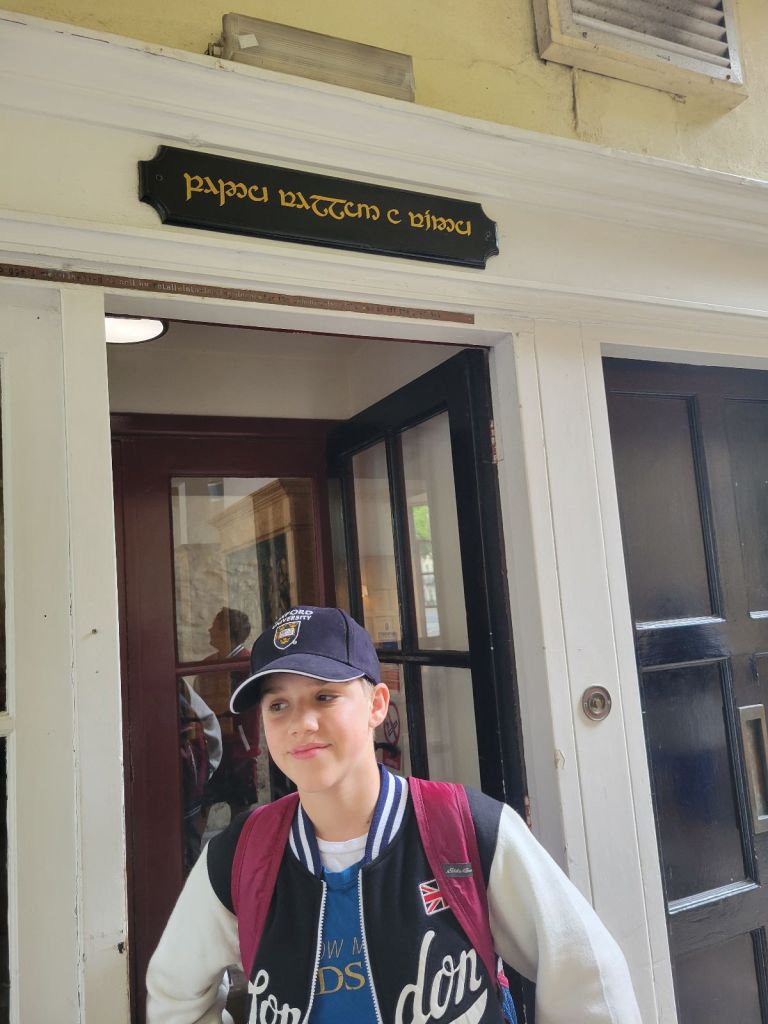
Hello, Everybody! I am writing this article from a cozy Airbnb in Oxford. Yes, the University Oxford! I was early this day walking around the town. I stopped and ate at Lamb and Flag. The Lamb was a frequented pub of the Inklings. It looks nice on outside and there is even an Elvish sign above the entrance. Also, around the back of the pub is an ancient looking path and an even older looking tree, but there in the path stands a lamppost…a Narnian lamppost perhaps.

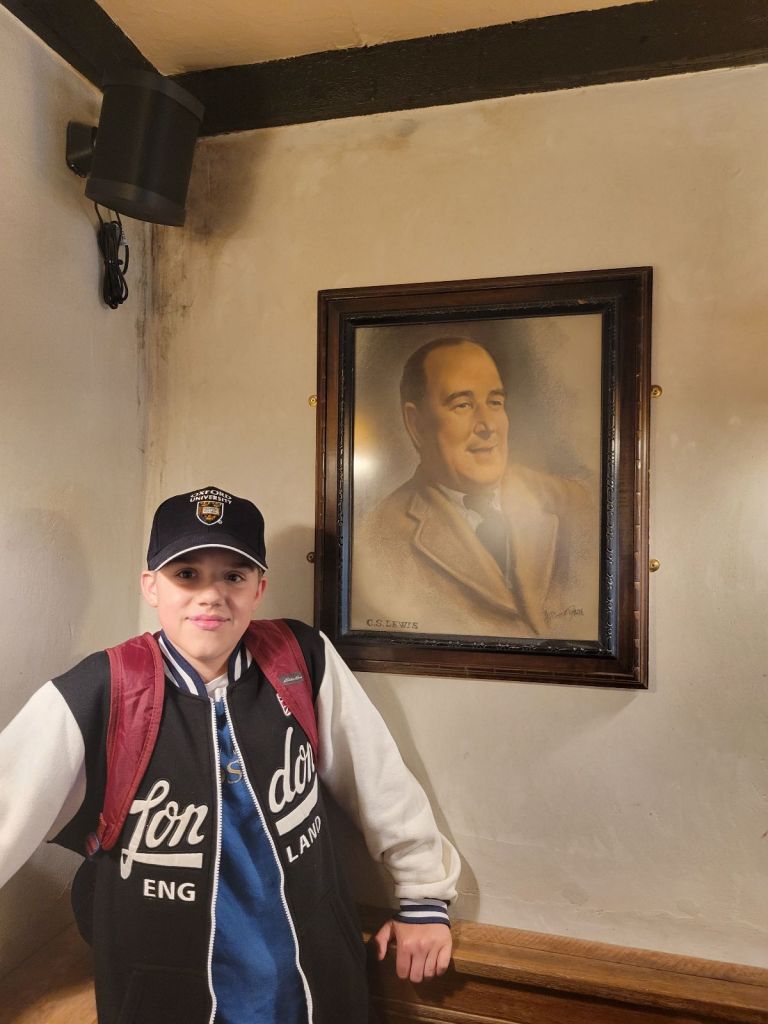
Upon entering, I found the building to be larger than I expected. I then notice the Tudor style rooms inside. Then I found a nice side room. I think it was the Inkling room. Why did I come to that assumption you may ask? Because there were two pictures adorning the wall. One was a photograph of the renowned J.R.R. Tolkien and his wife. The second an illustration of the famed C.S. Lewis.

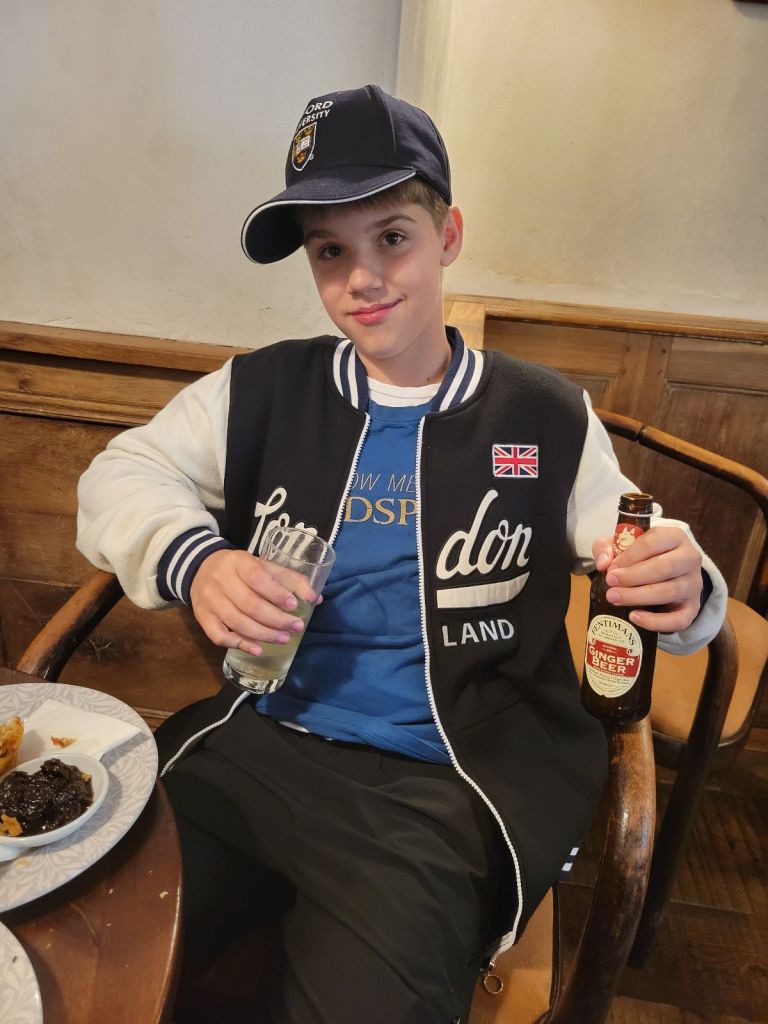
For a drink I had a decent Ginger Beer. For food, they do not sell warm food, so I had a cheese and ham croissant and a sausage roll.

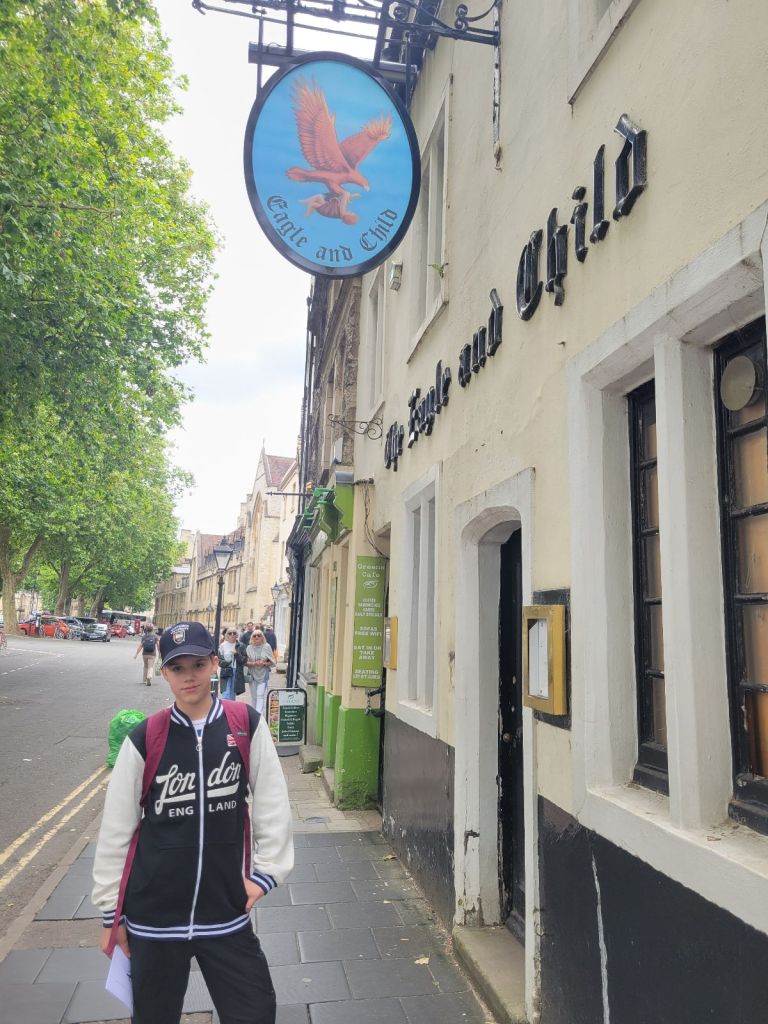
The Eagle and Child was closed, which was a disappointment, but it was still fun to see such an iconic and influential pub in the lives of Tolkien and Lewis and all the other Inklings!

-A.L.Spears

A Coin Flip, A Science Fiction Wager

One day in the 1900s two men sat discussing late into the night, they sat around a table in the pub The Eagle and the Child. These two men were J.R.R. Tolkien and his best friend C.S. Lewis. These two Inklings were discussing and debating over the concepts of space travel and time travel. How would it work? What would it be like? Back and forth they went. They were unsatisfied with the stories of space and time travel that they were reading. So they flipped a coin. Lewis got space travel and Tolkien end up with time travel. And so they set out to craft there stories.

Lewis was a rapid writer and soon an entire trilogy came from this wager. The trilogy is known as The Space Trilogy or the Ransom Cycle. The first book was Out of the Silent Planet, the next Perelandra, and finally This Hideous Strength. The story tells of how a man visited different planets in the solar system governed by celestial beings. Each planet he visits has a different Genesis theme, and his goal is to stop a Satan-like villain from his evil schemes.

Tolkien on the other hand was slow and tedious writer. Of his time travel tale he only made four chapters. These four chapters can be found in The lost Road one of the twelve histories of Middle-earth. His story tells of a father and son being reembodied in different eras, starting with Edwin and Elwin in the modern age. They resurface again as Eadwin and Aelfwine from Anglo-Saxon legend, and then Aubidoin and Alboin from Lombardic. The time travel stretches all the way back to Tolkien;s Numenorian characters, Amandil and Elendil.

He said of his tale, “I began an abortive book of time-travel of which the end was to be the presence of my hero in the drowning of Atlantis. This was to be called Numenor, the land in the west. The thread was to be the occurrence time and again in human families (like Durin among the dwarves) of a father and son called by names that could be interpreted as Bliss-friend and Elf-friend.”

Since Tolkien never completed his work. he did not publish it but his son Christopher would later publish the fragment. It can be found in The Lost Road and other writings. It is the fifth book in the history of Middle-Earth series.

C.S. Lewis and J.R.R. Tolkien were both great writers, changing the genres of fantasy, Christian life, and science fiction together.

The Inklings Themselves

Who exactly were the Inklings?

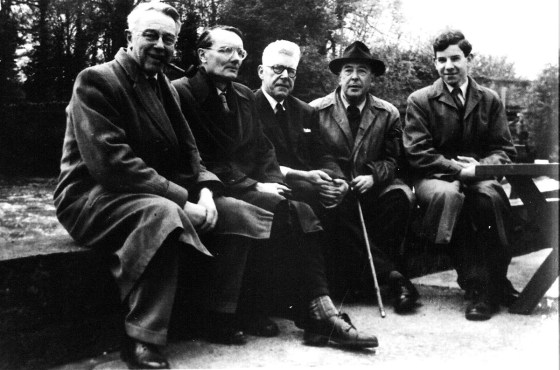
They were a literary group or club in Oxford, England. They frequented two Oxford pubs: The Eagle and the Child, and The Lamb and Flag. There were twelve regular members and frequent attendees of the Inklings.

J.R.R. Tolkien, possibly the most famous Inkling, was born in Bloemfontein, South Africa in 1892. He moved to England at a young age after his father died. He studied at Exeter College, Oxford. He served in World War One and became a professor of Anglo-Saxon at Oxford. He published The Hobbit in 1937 and The Lord of the Rings in 1954. He was a devout Catholic. He died in 1973 at the age of eighty-one years old.

C.S. Lewis, also possibly the most famous Inkling, was born in 1898 in Belfast, Ireland. He changed his name from Clive Staples to Jack. His mother died when he was nine. He served in World War One, and after the war worked at Oxford and Cambridge University. After World War Two, he wrote many books such as The Chronicles of Narnia, The Screwtape Letters, The Space Trilogy, and Mere Christianity. He died of kidney failure at the age of sixty-four.

Charles Williams was born in London in 1886. He went to school at St. Alban’s, and he worked at Oxford University Press. He published and wrote many things like poetry, theology, drama, history, biography, and book reviews. He lived too far from Oxford to be a regular member of the Inklings at first, but after he moved there he became a regular member. He died in 1945.

Owen Barfield was born in London. He went to school at Highgate and attend Wadham College, Oxford. He had a degree in English language and literature. He was an author and a poet and was a founding father of a new spiritual movement. Barfield was known as “the first and last Inkling,” founding the club and living the longest. In fact, C.S. Lewis dedicated The Lion, the Witch, and the Wardrobe to his daughter, Lucy Barfield. Owen Barfield died in 1997 at the age of ninety-nine.

Henry Victor Dyson Dyson was born in 1896. He was commonly referred to as Hugo Dyson. He was an expert in Shakespeare, but he was not a very active writer himself. Together, he and Tolkien converted C.S. Lewis to Christianity. He died at the age of seventy-nine in 1975.

Christopher Tolkien, the son of J.R.R. Tolkien, was born in Leeds, England. He was ever the little editor of his father Tolkien’s works from a very young age, criticizing the book if was not consistent. During World War Two, he served in South Africa as a British air force pilot. After the war, he attended Trinity College, Oxford. He was invited by his father to become a member of the Inklings. After his father’s death, he was the owner of the Tolkien estate and the editor of all Tolkien’s left behind works.

Warren Lewis, C.S. Lewis’ brother, was born in 1895 in Belfast, Ireland. For his career, he was an army officer and Irish historian. He fought in both the World Wars. He published several history books. Warnie was sadly an alcoholic and died at the age of seventy-seven in 1973 at Oxford.

Adam Fox was born in 1883. He was the headmaster of Radley College for some time. In fact, he was one of the very first Inklings. He wrote an enormous poem across four volumes titled, “Old King Cole.” He attempted to greatly promote Plato among the classics. He met his end in 1977.

Dr. Robert Emlyn Havard was the doctor of C.S. Lewis, Lewis’ wife, and Tolkien. He wrote the appendix for C.S. Lewis’ book, The Problem of Pain. Like Tolkien, he was a devout Catholic. One day when he was late to the meeting, Warnie Lewis referred to him as “the useless quack.” Following this, his nickname became “the U.Q.” On another day, Hugo Dyson called Havard “Humphrey” as he could not recall his first name. From that point on, the others called him Dr. Humphrey. He died in 1985.

Lord David Cecil, another Inkling member, was born in 1902 in England. He developed his love for reading because of a medical operation that made him stay in bed for a long time. He studied Christ College, Oxford. His first book was The Stricken Deer in 1929. He then worked on writings about Walter Scott and Jane Austen. Mostly working in Oxford as a professor, he joined the Inklings and eventually died in 1986 at the age of eighty-three.

Nevill Coghill was born in 1899. He was a director of drama and an Anglo-Irish scholar. He studied at Exeter College. He also made a modern version The Canterbury Tales and of Shakespeare’s works. He died in 1980.

Jack A.W. Bennett was born in Auckland, New Zealand. He studied at the University of Auckland, and sometime after this, he moved to Oxford and studied and taught there. He was the best known scholar of Middle English and was a fellow of C.S. Lewis. He died in 1980.

Now you will never forget the Inklings and how they have influenced our world today.

The Life of C.S. Lewis

Who is C.S. Lewis? Today we will examine together who the man behind the Chronicles of Narnia truly is.

C.S. Lewis was born November 29, 1898 in Belfast, Ireland. His father was a lawyer and his mother was a mathematician who taught Lewis and his brother Warnie. Lewis’ full name was Clive Staples Lewis. As a kid, he did not like this horrid name, so he changed it to Jack. His mother died of cancer when he was nine years of age. His father sent him to a boarding school. His father was very demanding and did not understand how to raise children, and the brothers did not like their dad’s parenting skills. After his mother died, Jack left the true faith of Christianity.

Later, Jack studied under a tutor, the same one that his brother and father had studied under. He learned to read the classics in Greek and Latin. He was also greatly inspired by George MacDonald. He was studying for the Oxford exam, but he failed. He tried again and failed. Then he went off to serve in World War One. The experience influenced him greatly. He had a traumatizing time.

After the war, Oxford let soldiers enroll for many former students had died. Jack became a scholar and then a teacher at Oxford. He made friends with J.R.R. Tolkien and a club of writers called the Inklings that included Tolkien and Hugo Dyson. He reconverted to Christianity with the help of Tolkien and Dyson and they had a deep friendship.

After his conversion, World War Two overtook Europe. A few of the Inklings joined the war effort, and some of the younger Inklings enlisted as soldiers. Christopher Tolkien, the son of J.R.R. Tolkien, was one of these. Lewis met another great friend and Inkling, Charles Williams, during this time.

During and after the war, Lewis wrote many books including The Screwtape Letters, The Chronicles of Narnia, and The Space Trilogy. He took a position as professor at Cambridge since Oxford would not promote him. He married Joy Davidson in his fifties. A few years later, Joy got cancer and died. Lewis was greatly grieved and wrote a book on his sorrow. He died of kidney failure one week before his sixty-fifth birthday.

C.S. Lewis, or Jack, was a famous scholar, author, theologian, and Inkling.

REVIEW of The Screwtape Letters By C.S. Lewis

The Screwtape Letters by C.S. Lewis is a really funny read and is a really odd book altogether.

The setting of the story is in the 20th century England. And in a way Hell because Screwtape is in hell writing the letters.

One of the many characters that are featured in the book is Screwtape. He is a demon secretary, adviser, and mentor. He is quite the boaster of his tempting days. Another Character is the Jr. tempter Wormwood. He writes to his uncle Screwtape to inform him of his progress of the Patient and his attempts to tempt which mostly end poorly. The Patient is a Human Like me and you. he lives in England and goes about his life unbeknownst to the Demons behind the scenes. Some of the other people mentioned by Screwtape is Our Father Below who is Satan. and the Enemy who is the true God.

The Plot of the story is about the designs of Screwtape and Wormwood trying to deceive the Patient. And the blundering mistakes that Wormwood makes again and again until he looses the Patient to the Enemy.

The Theme of the Screwtape letters is to show us a new and different perspective on life and tell us how to live in a more Godly way.

Any C.S. Lewis fans would enjoy and find helpful the Screwtape letters.

-A.L. Spears

Greek Mythology in Narnia

The Chronicles of Narnia by C.S. Lewis were greatly influenced by the myths of classical Greece. The fauns, dryads, and Bacchus all appear in Lewis’ tales alongside Aslan and the Pevensie children.

Mr. Tumnus, the faun from The Lion, the Witch, and the Wardrobe, and all other Narnian fauns were inspired by Greek fauns and Pan the demigod. Both Narnian fauns and Greek fauns all share the same appearance, being half-man and half-goat. The upper half is a man’s body with goat horns sprouting from the head. The lower half is goat legs and hooves. Mr. Tumnus has a wooden flute just like Pan’s, yet another similarity between the two.

Another Greek inspiration are the nymphs and dryads. For those who do not know, the nymphs are Greek water spirits, and the dryads are Greek tree spirits. The Narnian nymphs and dryads are very similar to the Greek ones and appear throughout the Chronicles. Virtually everything is alive in Narnia, from talking animals to tree and river spirits.

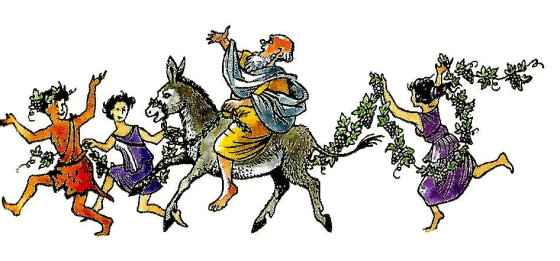
Along with demigods and nymphs, one of the Greek gods himself makes an appearance in the books. In Prince Caspian, it describes a wild feast where a man riding a donkey “who was old and enormously fat” is passing out refreshments. The refreshments consist of wine and grapes. The man, who we later learn is Bacchus, is surrounded by wild dancing girls. Bacchus is Dionysius, the son of Zeus, the god of wine and revelry.

As seen above, the Greek myths greatly inspired the Chronicles of Narnia, and the books would not be the same without them.