
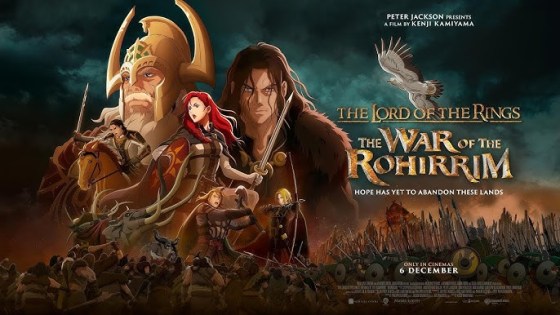
Overview of Plot
The War of Rohirrim’s plot was well done and extremely book accurate which is so nice to see in an Middle-Earth adaptation. The movie starts out with Miranda Otto reprising her role as Eowyn to narrate the movie. Eowyn gets us back into the Middle-Earth mind set and sets up the time frame of the movie which is 183 years before the LotR. Eowyn also introduces us to one of the main characters, Hera, and how she was raised by a warrior king. Eowyn says do not look at the old songs for mention of her because there is none, and that is because in the original story she is just the unnamed daughter of Helm. The plot then ramps up into a brawl then a war. We saw all the lore monuments that we expected to see including the Brawl, the siege of the Hornburg, and the death of Helm; and in the end, a certain white wizard comes to take over Isengard. The plot flowed well even with the several time jumps which are hard to do but they all worked great.
Favorite Characters and Events
My top favorite character is Helm Hammerhand. His voice, played by Brain Cox, was great and what I imagined for his voice. The brawl scene and war council scene splendidly showed Helm’s arrogance and how he is not the best hero or king. The scene when he freezes to death fighting an army of Dunlendings was a stunning sequence where he somewhat redeems himself protecting his daughter and the gate.
Fréaláf was another great character. When he is scolded for making the wise plan of defense, he was outcast from the army even though his plan was a good one. To see him on the throne at the end was fitting and satisfying. Fréaláf at Dunharrow had great visuals; Dunharrow looked just like the stronghold from the original film despite this one being Anime.
I enjoyed the opening scenes and the visuals of the Hornburg; the ice and snow was cool (pun intended). I love how you did not immediately see Helm attack, and in a way, you felt the terror of the Dunlendings as the Wraith of Helm Hammerhand stalks you in the frozen night.
The two Orcs collecting rings was a fun original aspect. It worked well in the movie and did not contradict any lore. It made sense that Sauron, who desperately need his Ring back, would send out his orcs to collect rings in search of his or any other of the rings of power. It also makes sense how Sauron would not trust his orcs with the true knowledge of why they collected rings. And as a bonus, the orcs were ironically voiced by Billy Boyd and Dominic Monaghan (Merry and Pippin from the LotR films).
Least Favorite Characters and Events
I enjoyed all the characters very much—they all fit really well with the lore and the world of Middle-Earth. However, there was one character who looked more Anime than Middle-Earth in style. Hama, the son of Helm Hammerhand, had very Anime boyband style hair and also had earrings. This look didn’t fit with the rest of the Rohirrim.
One thing I did not like was the whole Eagle plot. In a way, it cheapens the role of the eagles in the other movies. If every time one thing goes wrong the eagles are always there, it shows people as helpless. Tolkien did not write his stories that way.
The battle outside of Edoras was not as impressive as in the LotT trilogy because you did not get to see the scale of the battle. This is probably just because it is harder to do that in an Anime film.
Also, in the end the movie shows Hera overpowering Wulf in their fight. Realistically, that could not happen. She is somehow really good at climbing really, really high mountains without any training? Then, she is proficient in jumping large distances to large distances? It was somewhat unbelievable.
Source Material
The movie was very lore accurate unlike some Amazon adaptations I have heard of. There were things they added (and almost every single one worked well), and there were no big lore cuts. I saw everything I wanted and expected to see lore-wise. I would venture to say this movie is more Lore accurate than the originals only because it has a lot less info to be true to. Despite this, I would still choose the originals over The War of the Rohirrim any day because Peter Jackson’s originals cannot be beat.
Overall Assessment
I really enjoyed the movie as a whole. It was so, so, so nice to get a good Tolkien adaptation after a gap of maybe 20 or more years. If the fact that it is anime bothers you, I encourage you to give it a shot. I have never liked Anime, but that was not a problem after the first 5 minutes. It was more Middle-Earth than Anime. I Give the War of the Rohirrim an 8 out of 10.

 Inkling Investigation